Thursday, April 4, 2013

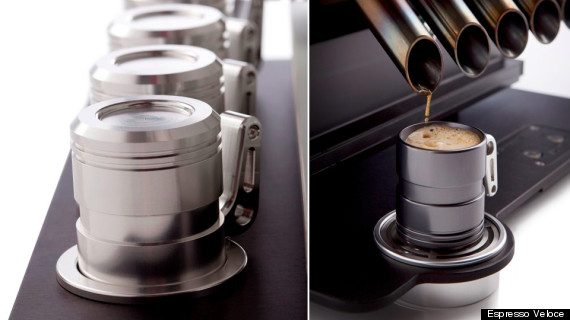
V12 Espresso Machine From Espresso Veloce Is Intimidating Us (PHOTO)

So... this thing is intense. What you're looking at is not a car engine, although it is modeled to make you think it is one. Instead of exhaust fumes, this contraption emits shots of espresso. This monster, dubbed the Espresso Veloce is made of titanium, magnesium and aluminum, and they will only make 500 of them.

Remember the car with the espresso machine built into it? This is a bit like that, only meant to live in your kitchen. So if you are rich, caffeine-oriented and a bit of a gear-head, we may have found your birthday present. This v12 espresso machine will probably keep you running on all cylinders all day. (Sorry.)

v12 espresso

[via The Awesomer]

Want to read more from HuffPost Taste? Follow us on Twitter, Facebook, Pinterest and Tumblr.

Also on HuffPost:

"; var coords = [-5, -72]; // display fb-bubble FloatingPrompt.embed(this, html, undefined, 'top', {fp_intersects:1, timeout_remove:2000,ignore_arrow: true, width:236, add_xy:coords, class_name: 'clear-overlay'}); });

Source: http://www.huffingtonpost.com/2013/04/03/v12-espresso-machine_n_3001633.html

turkey brine Imessage Not Working mc hammer pecan pie recipe Hector Camacho Jill Kelly McKayla Maroney

A longer life for lithium-sulfur batteries

Apr. 2, 2013 ? Electric cars have still got it tough in the German marketplace. They are too expensive and their range is too short. This is an opportune time for a breakthrough in efficient and low-cost lithium-sulfur batteries.

There are currently over 40 million cars on Germany's roads. Only a fraction of them are powered by electric energy -- around 6,400 vehicles according to the Federal Ministry of Transport, Building and Urban Development. The comparatively short range of electric cars doesn't help their popularity, with drivers often having to start the search for a charging station after a mere 100 kilometers, not to mention the high price of the batteries, which cost several thousand euros. Remedying this situation has researchers looking at new options in developing more efficient technologies. An extremely promising avenue of research is the lithium-sulfur battery, which is significantly more powerful and less expensive than the better-known lithium-ion battery. Although their short lifespan has made them unsuitable for use in cars before now, this may be about to change in the foreseeable future.

Scientists at the Fraunhofer Institute for Material and Beam Technology IWS in Dresden have developed a new design that increases the charge cycles of lithium-sulfur batteries by a factor of seven. "During previous tests, the batteries scarcely crossed the 200-cycle mark. By means of a special combination of anode and cathode material, we have now managed to extend the lifespan of lithium-sulfur button cells to 1,400 cycles," says Dr. Holger Althues, head of the Chemical Surface Technology group at IWS, who is delighted with his team's breakthrough. The anode of the team's prototype is not made from the usual metallic lithium, but from a silicon-carbon compound instead. This compound is significantly more stable, as it changes less during each charging process than metallic lithium. The more the structure of the anode changes, the more it interacts with the liquid electrolyte, which is situated between the anode and the cathode and carries the lithium-ions. This process causes the liquid to break down into gas and solids and the battery to dry out. "In extreme cases, the anode "grows" to reach the cathode, creating a short circuit and causing the battery to stop working altogether," explains Althues.

The interplay between anode and cathode is the critical factor determining the performance and lifespan of a battery. In the lithium-sulfur model, the cathode is composed of elemental sulfur. The advantage here is that unlike cobalt -- the main cathode material used in lithium-ion batteries -- sulfur is available in almost unlimited quantities and is therefore cheaper. The problem remains, however, that sulfur also interacts with the liquid electrolyte, which impairs the performance of batteries and, in the worst case, causes them to lose capacity entirely. The IWS researchers are using porous carbons to slow down this process. "We have precisely altered the pores to allow the sulfur to lodge there, slowing down the rate at which it combines with the electrolyte," clarifies Althues. He and his colleagues have developed a method of manufacturing these special cathodes.

The experts at IWS measure the capacity of a battery in watt-hours per kilogram (Wh/kg). Over the long term, they expect lithium-sulfur batteries to reach an energy density of up to 600 Wh/kg. For comparison: the maximum energy density of the lithium-ion batteries currently in use is a mere 250 Wh/kg. "In the medium term, figures around the 500 Wh/kg mark are more realistic. In practical terms, this means you can drive twice as far with the same battery weight," says Althues. This of course implies that significantly lighter battery models are possible -- an interesting prospect not only for automakers but for smartphone manufacturers too. After all, the overall weight of smartphones would be greatly reduced if they had lighter batteries. "Lithium-sulfur technology might even make electric flying a realistic possibility. Although such progress is still a long way off," adds Althues.

The researchers are currently working on further optimizing the material and using it in larger battery models. They are also turning their attention to suitable manufacturing methods. And with good reason, as this is the only way the technology will reach a mass market, leading to a significant increase in the number of electric cars on Germany's roads.

Share this story on Facebook, Twitter, and Google:

Other social bookmarking and sharing tools:


Story Source:

The above story is reprinted from materials provided by Fraunhofer-Gesellschaft.

Note: Materials may be edited for content and length. For further information, please contact the source cited above.


Note: If no author is given, the source is cited instead.

Disclaimer: Views expressed in this article do not necessarily reflect those of ScienceDaily or its staff.

Source: http://feeds.sciencedaily.com/~r/sciencedaily/most_popular/~3/kg-pLe_c9xY/130402091245.htm

jake owen oosthuizen louis double eagle bubba masters winner instagram facebook chicago cubs

Wednesday, April 3, 2013

Energy supplier SSE fined ?10.5 million for mis-selling

LONDON (Reuters) - Britain's energy regulator has fined gas and electricity supplier SSE ?10.5 million for mis-selling, the largest fine it has ever imposed on an energy supplier.

Ofgem said on Wednesday it had found failures relating to telephone, in-store and doorstep sales at SSE "at every stage of the process", including at management level.

"The level of fine reflects the seriousness and duration of breaches, the likely substantial harm that they have caused and the likely gain to SSE," it added.

Ofgem said SSE - which provides gas, electricity, phone and broadband for households - had made misleading and inaccurate statements to customers in order to make a sale.

Examples it gave included telling customers they would save money but switching them to a more expensive contract and telling them competitor price increases were higher than they actually were.

Although SSE's management had not wilfully breached licence conditions, the board paid insufficient attention to compliance and it was not a high priority for it, Ofgem said.

The regulator launched investigations into selling practices by SSE, EDF, RWE's npower and Ibedrola's Scottish Power in 2010, and by E.ON in 2012.

Last year, EDF paid out 4.5 million pounds to help vulnerable consumers after Ofgem found it had breached some licence conditions in its sales and marketing.

The investigations into npower and Scottish Power are ongoing.

"SSE is deeply regretful that breaches occurred and apologises unreservedly to any customers who have been affected by sales activity which ran counter to the values and culture of the company," SSE said.

It said it had already taken action to remedy the issues raised, including stopping doorstep selling, bringing telesales in-house, and training and restructuring.

SSE has already been fined 1.25 million pounds for doorstep mis-selling by the courts. It has earmarked 5 million pounds to reimburse customers who felt they have been misled.

It has paid out around 400,000 pounds of this so far.

(Reporting by Rosalba O'Brien; Editing by Kate Holton and Mark Potter)

Source: http://news.yahoo.com/uk-energy-regulator-fines-sse-mis-selling-062715325--finance.html

casey anthony dennis rodman history channel mila kunis hugo chavez rand paul Iron Man 3

This Could Be the World's Smallest Night Vision Camera

When you're creeping outside someone's bedroom at night trying to get shots of them sleeping, the last thing you need to deal with is a bulky pair of night vision goggles. So stalkers of the world rejoice; JTT has designed what looks like the smallest night vision camera ever that lets you stay as inconspicuous as possible. More »


Source: http://feeds.gawker.com/~r/gizmodo/full/~3/EPCm9-4z4fI/this-could-be-the-worlds-smallest-night-vision-camera

jermaine jones hbo luck unc asheville stephen jackson marchmadness mike d antoni nba trade rumors

U.S. to re-examine health effects of cellphone radio waves ...

A technician examines a mobile phone in a test room at the Market Surveilance Laboratories of the Information and Communication Technologies Authority of Turkey, in Ankara June 9, 2011. Founded in 2007 with funds from the European Union, the facility, comprising of five different labs, tests mobile telephones and other communication devices to determine their Specific Absorbition Rate (SAR) value. SAR is a measurement of how much electromagnetic radiation is absorbed by body tissue whilst using a mobile phone.

U.S. regulators are looking into how radio frequencies emitted by cellphones and other wireless devices affect people amid lingering concerns about the risks of cellphone radiation.

The Federal Communications Commission said on Friday it is seeking comment from other agencies and health experts on whether it should update its standards limiting exposure to phones' electromagnetic fields, as they apply to children in particular.

The FCC last reviewed those standards in 1996, before the ubiquitous use of mobile devices. But the agency's officials say they have no reason to believe the current standards are inadequate and called the proceeding, which was announced in documents posted online on Friday, a routine review.

Scientists have been unable to determine whether radio waves emitted by mobile devices pose threats to the brain or other parts of the human body but studies continue as the number of mobile devices Americans own, already in the hundreds of millions, continues to grow.

Source: http://www.theoaklandpress.com/articles/2013/04/02/news/story_13f5b95d-48d3-4336-9a8b-84bcd2c0315a.txt

opm revolution nascar tiger woods passover Florida Gulf Coast University Aaron Craft

Hands-on with the smaller, less expensive 7-inch Wikipad (video)

Handson with the smaller, less expensive 7inch Wikipad

When the Wikipad went from 10.1-inches to just 7-inches earlier this year, subsequently cutting its price in half alongside the size reduction, the gaming-centric Android tablet went from riskily priced potential failure to affordable item of interest in one swift move. $500 for a 10.1-inch tablet with a proprietary gaming controller peripheral? With a Tegra 3, no less? That already sounds outdated, and at $500, it sounds outright crazy. Though Wikipad promises a 10.-1-inch version is still in the works, the 7-incher is headed for retail in the coming weeks, with the aforementioned Tegra 3 quad-core SoC, a 1,280 x 800 IPS screen, Jellybean 4.1, and that enormous detachable game controller (12 buttons in all!). At last week's Game Developers Conference, we had a chance to check out the latest version of the Wikipad just ahead of its retail launch -- for more on that meeting, join us beyond the break.

Filed under: , ,

Comments

Source: http://feeds.engadget.com/~r/weblogsinc/engadget/~3/phsXUpo4zbw/

doug hutchison larry brown thomas kinkade pat summit brewers matt cain adastra

Soils in newly forested areas store substantial carbon that could help offset climate change

Apr. 1, 2013 ? Surface appearances can be so misleading: In most forests, the amount of carbon held in soils is substantially greater than the amount contained in the trees themselves.

If you're a land manager trying to assess the potential of forests to offset carbon emissions and climate change by soaking up atmospheric carbon and storing it, what's going on beneath the surface is critical.

But while scientists can precisely measure and predict the amount of above-ground carbon accumulating in a forest, the details of soil-carbon accounting have been a bit fuzzy.

Two University of Michigan researchers and their colleagues helped to plug that knowledge gap by analyzing changes in soil carbon that occurred when trees became established on different types of nonforested soils across the United States.

In a paper published online April 1 in the Soil Science Society of America Journal, they looked at lands previously used for surface mining and other industrial processes, former agricultural lands and native grasslands where forests have encroached.

U-M ecologist Luke Nave and his colleagues found that, in general, growing trees on formerly nonforested land increases soil carbon. Previous studies have been equivocal about the effects of so-called afforestation on soil carbon levels.

"Collectively, these results demonstrate that planting trees or allowing them to establish naturally on nonforested lands has a significant, positive effect on the amount of carbon held in soils," said Nave, an assistant research scientist at the U-M Biological Station and in the Department of Ecology and Evolutionary Biology.

"These forest soils represent a significant carbon reservoir that is helping to offset carbon emissions that lead to climate change," said Nave, lead author of the paper.

Large and rapid increases in soil carbon were observed on forested land that had previously been used for surface mining and related industrial processes. On a post-mining landscape, the amount of soil carbon generally doubled within 20 years of mining termination and continued to double every decade or so after that.

The changes after cultivated farm fields were abandoned and trees became established are much subtler, though still significant. This type of tree establishment -- which has been widespread in recent decades in the northeastern United States and portions of the Midwest -- takes about 40 years to cause a detectable increase in soil carbon.

But at the end of a century's time, the amount of soil carbon averages 15 percent higher than when the land was under cultivation, with the biggest increases (up to 32 percent) in the upper two inches of the soil.

In places where trees and shrubs have encroached into native grassland, soil carbon increased 31 percent after several decades, according to the study. That type of incursion is occurring throughout the Great Plains, from the Dakotas all the way to northern Texas, and is largely due to suppression of wildfires.

"Our work helps those tasked with understanding and managing the carbon balance of U.S. lands by putting a number on the changes in soil carbon that occur during this sort of land-use transition," Nave said.

Most of the organic carbon in forest soils comes from the growth and death of roots and their associated fungi, he said.

The study involved a reexamination of 46 research papers published between 1957 and 2010, as well as an analysis of 409 soil profiles from the National Soil Carbon Network database.

Co-authors of the Soil Science Society of America Journal article are Chris Swanston of the U.S. Forest Service, Umakant Mishra of the Argonne National Laboratory and Knute Nadelhoffer, director of the U-M Biological Station and a professor in the Department of Ecology and Evolutionary Biology.

The work was supported by the U.S. Forest Service and the National Institute of Food and Agriculture.

Share this story on Facebook, Twitter, and Google:

Other social bookmarking and sharing tools:


Story Source:

The above story is reprinted from materials provided by University of Michigan, via Newswise.

Note: Materials may be edited for content and length. For further information, please contact the source cited above.


Journal Reference:

  1. L. E. Nave, C. W. Swanston, U. Mishra, K. J. Nadelhoffer. Afforestation Effects on Soil Carbon Storage in the United States: A Synthesis. Soil Science Society of America Journal, 2013; DOI: 10.2136/sssaj2012.0236

Note: If no author is given, the source is cited instead.

Disclaimer: Views expressed in this article do not necessarily reflect those of ScienceDaily or its staff.

Source: http://feeds.sciencedaily.com/~r/sciencedaily/top_news/~3/5w72tAS0rDY/130401110744.htm

world peace elbow kevin love think like a man world peace world peace lakers colorectal cancer metta